Straight answers, before you ask.
Pricing, formats, POST status, class sizes: the questions agencies ask most, answered the way we'd answer them on a call. If yours isn't here, the contact form reaches a real person.
Training Basics
What is public safety leadership training?
It is structured leadership development for the people who supervise public-service teams: law enforcement, fire departments, EMS, and local government. It is not tactical or technical instruction. It covers the supervisory work itself, including setting a standard and holding it, running briefings and debriefs, having critical conversations, documenting performance, and deciding under pressure. Thatcher Lewis delivers it as instructor-led, cohort-based training aligned to each agency's own general orders, SOPs, and policies.
What skills does the training teach?
The Essentials course covers supervisor toolkits, accountability and credibility, scenario labs, identifying leadership challenges, and tactical communication. The Executive course covers self-awareness and emotional intelligence, strategic decision-making, advanced conflict resolution, leading change and motivation, and executive coaching and early intervention. Both teach through scenario work rather than lecture, using situations rewritten around the decisions your supervisors actually face.
Who should attend?
Anyone who supervises, and anyone about to. Essentials is built for sergeants, field training officers, future sergeants, and civilian staff who lead administrative units. Executive is built for lieutenants, captains, watch commanders, battalion chiefs, EMS supervisors, and deputy directors. An agency can run both tiers in separate cohorts so the entire supervisory chain works from the same standard.
What is the difference between the first-line and executive courses?
Audience and altitude. Training Tomorrow's Leaders Today (Essentials) is first-line supervisor training: the daily mechanics of running a shift, coaching an officer, correcting a problem early, and keeping the standard the same on every tour. Executive Leadership Growth works at command level: crisis leadership, policy alignment, early intervention, and ethical decision-making across a whole organization. Both run two to five days, both are priced between $695 and $895 per student, and both are taught by Chief Jon Fehlman.
Courses & Pricing
What courses does Thatcher Lewis offer?
Two published courses: Training Tomorrow's Leaders Today (Essentials), built for sergeants, FTOs, future sergeants, and civilian staff, and Executive Leadership Growth, built for command staff and agency executives. Additional programs are in development and will be announced on the courses page when they are real.
How much does training cost?
Both published courses are priced between $695 and $895 per student, depending on cohort size and delivery format. The same band applies whether the class runs on-site, live online, or hybrid. There are no hidden platform or materials fees; a written proposal states the full price before you commit.
How long is a course?
Two to five days, depending on the tier and how much customization your agency requests. Hybrid delivery can spread those days across separate blocks instead of consecutive ones, and reinforcement coaching can extend beyond the formal training window.
What is the ideal class size?
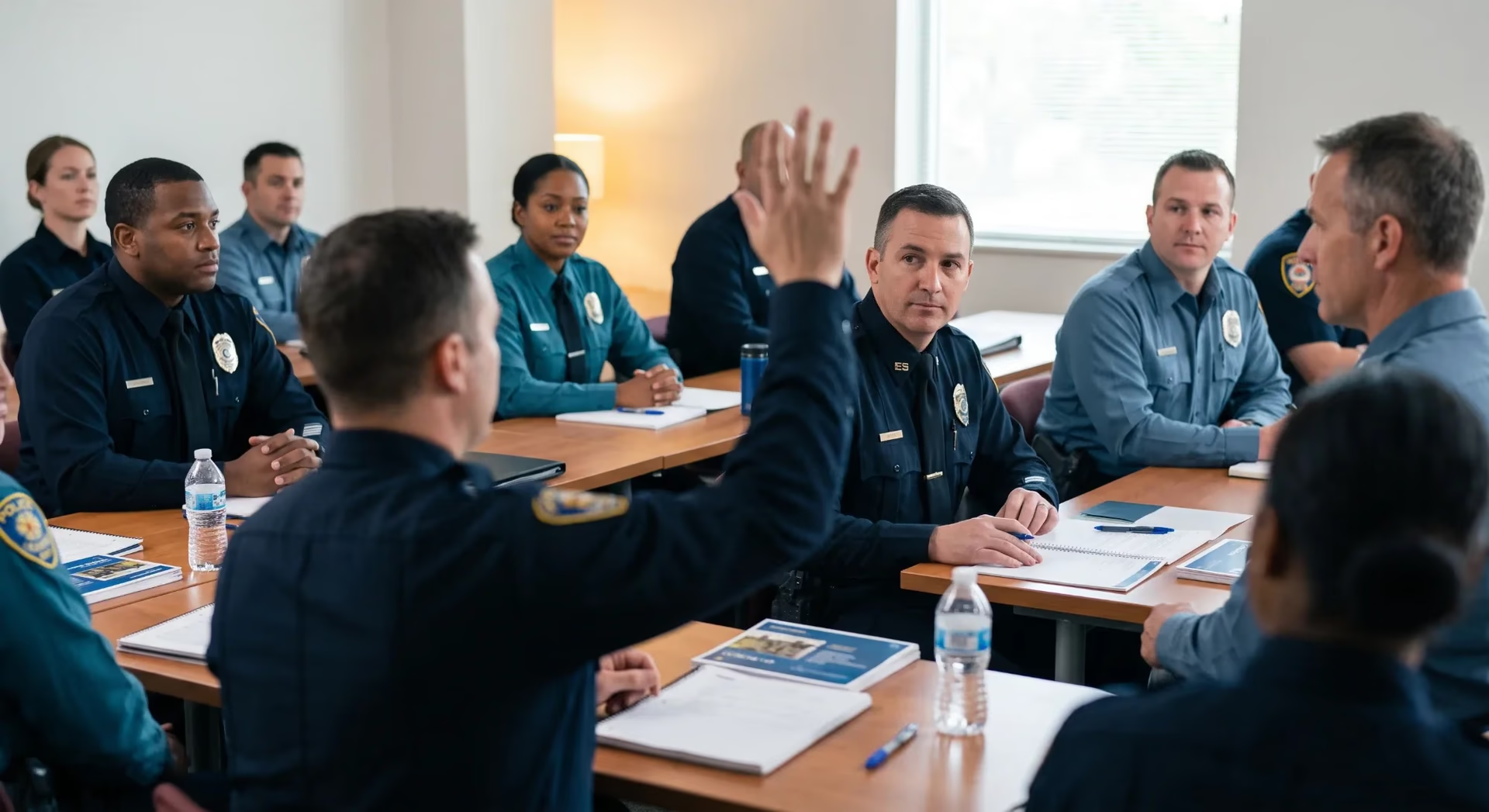
Fifteen or more students works best for scenario work and group discussion. The venue determines the maximum number of seats; regional multi-agency cohorts are available if your agency is smaller.
Are any of the courses offered at no cost?
No. Both published courses are paid engagements at $695 to $895 per student, and there is no promotional, trial, or no-charge version of either one. Before any commitment, though, your agency can take a discovery call and request the full documentation package, so your training coordinator can evaluate the course on paper first.
Delivery & Logistics
Is training delivered in person or online?
Both, plus a hybrid of the two. On-site means the instructor travels to your agency and the class runs in your own building. Live online means an instructor-led session in real time, not a recorded or self-paced library. Hybrid splits the days between the two. The curriculum, the instructor, the cohort model, and the documentation are identical in all three; what changes is travel, scheduling, and how the days are blocked. Thatcher Lewis trains nationwide across the United States.
Can our agency host a course?
Yes. The host agency provides a training room that seats the cohort, dates that fit its shift schedule, and an internal point of contact. Thatcher Lewis provides the curriculum, the instructor, and the documentation. Hosts control the calendar and can open the remaining seats to neighboring departments to reach the fifteen-plus cohort size.
Can multiple agencies attend one session?
Yes. Regional, multi-agency sessions let smaller departments share a cohort and split logistics, and the cross-agency discussion is consistently one of the most valued parts of the training.
How is the training customized to our agency?
Every engagement is aligned to your general orders, SOPs, and policies rather than delivered as an off-the-shelf slide deck. Scenarios are rewritten around the decisions your supervisors actually face, in your jurisdiction, under your discipline process. The learning objectives stay constant; the situations used to teach them change from one agency to the next, and how much of that rewriting you ask for is part of what decides whether a course runs two days or five.
Who teaches the courses?
Founder Chief Jon Fehlman teaches every flagship engagement personally. He is a career law enforcement leader serving since 1984, from patrol through chief of police. He is also DISC certified.
POST Credit & Certificates
Can courses qualify for POST credit or continuing education?
POST credit is not yet available. We provide learning objectives, hours, instructor bios, outlines, and assessments so your agency can submit courses for POST or local approval in your state.
Do students receive a certificate?
Yes. Completion certificates are provided for personnel files and training-record audits on request.
Is a completion certificate the same as a certification?
No. A completion certificate records the course title, the instructional hours, and the fact that a named person finished the training, which is what a personnel file and an audit need. It is not a professional credential or a license, and Thatcher Lewis does not describe it as one. Chief Jon Fehlman's DISC certification is his individual credential; completing a Thatcher Lewis course does not confer DISC certification on participants.
Is the training affiliated with FEMA or any federal certification program?
No. Thatcher Lewis has no affiliation with FEMA or any federal agency, and the courses carry no federal credential of any kind. Agencies looking for federal emergency-management coursework should go directly to FEMA's own training site at training.fema.gov, which is an independent government resource and not a Thatcher Lewis offering.
About the Firm
Where is Thatcher Lewis based?
The firm's mailing address is 1740 Old Fort Pkwy, #1003, Murfreesboro, TN 37129. There is no public walk-in office; training is delivered at client agencies nationwide, live online, or hybrid.
Who does Thatcher Lewis serve?
Four public services: law enforcement, fire departments, EMS, and public administration, from first-line supervisors through executives.
How do we get started?
Send the contact form or call (615) 987-6002. The first conversation is a discovery call about your goals, current challenges, and desired outcomes; a written proposal follows.

Didn't find your answer? Ask a person.
The form goes straight to our team, and calls are answered by people who can actually quote scope and dates, not a phone tree.